The Carol Shields Prize Foundation Fellowship at Diaspora Dialogues provides financial support to a woman or non-binary BIPOC writer who is a refugee or new immigrant to Canada. The stipend is intended to provide opportunity for a writer to create more freely from financial constraints.
As a part of the Fellowship, the recipient also receives the support of a mentor to provide structured feedback on their work, as well as access to Diaspora Dialogues’ suite of professional development training and networking events.
The Carol Shields Prize Foundation and Diaspora Dialogues are deeply grateful to the M.A. Faris Foundation for supporting this Fellowship. Learn more about the fellowship on our programs page.
“Sometimes I worried that some of the stories I was trying to braid together seemed too dispersed or disconnected, so it was a relief to see my mentor, Matthew, not only find these connections but also show me new ways they come together, and share reflections of his own that ultimately added new layers to the themes I’m so passionate about. Having a mentor also forced me to organize my progress and put things in writing, like the overall structure. In short, I’m incredibly thankful to have a second pair of eyes accompanying me through this process, and I couldn’t have asked for a better mentor.”
We asked Laura Morales Padilla, the 2026 Carol Shields Prize Foundation Fellowship at Diaspora Dialogues recipient, some questions about her transformative experience. Laura talked about how getting the fellowship made her believe her own story is worth telling, and how the mentorship process allowed her to hone in her writing skills and grow as a writer.
The Carol Shields Prize for Fiction (CSPF): Can you tell us about the project you have been working on during the Carol Shields Prize Foundation Fellowship at Diaspora Dialogues?
Laura Morales: Absolutely. I’m working on a non-fiction book of braided stories. It starts with the story of my first protest, alongside the changes I witnessed after Bolivia elected its first indigenous president—with whom I shared the same last name—and the increased presence of drug trafficking near my city.
How did I end up in Canada? After a decision that felt outside my control, my brother and I joined the hundreds of thousands of international students who arrived in Canada right before the federal government realized that post-secondary institutions were recruiting students at the same frantic rate as miners extracted tin in wartime.
From grappling with the guilt of leaving my home country to witnessing the harsh realities of migrants from less developed countries, this project is about the people who have shaped my beliefs—people who opened my eyes to my own prejudices and challenged my idealized vision of North America. In short, this book is about people who care in a system that doesn’t care about people.
CSPF: What are the major themes or ideas that your work engages with?
Laura: One of the main themes is permanent temporariness. I came across this term when I was doing some research on Canadian immigration. As an international student with dual intent (the legal term for someone who is here on a temporary permit but also has the intention of staying), I immediately resonated with this concept. I found it comparable to being on a bridge: Like any liminal space, it's not designed for anyone to stay for long periods of time, because whatever you build, you have to be prepared to leave behind. So, after almost four years of residing on this bridge, I've noticed it getting more and more crowded—and not only with immigrants.
This leads to another important theme: resilience and the way we often romanticize it. I used to think that this ability to adapt to any circumstances and still find moments of joy was a way to challenge a system that was not designed to include us, like a seedling growing out of a little crack in the pavement. But when I started writing about the shared experiences of international students in a more journalistic way, it led me to zoom out and understand the policies and institutions that are at play. It made me question whether resilience has a role within these exploitative systems, and if our resilience is in a way being used against us, how can we reclaim it?
I also reflect a lot on what it means to be radical, because it currently has a very negative connotation and is often used as a synonym for extreme and even irrational. But radical comes from the Latin word radix, which means 'root.' A radical solution, for instance, would not be about seeking amendments or reforms, but rather about reaching the heart of an issue and then trying to address it. With this in mind, I reflect on how memory serves a radical purpose, and on my experience witnessing a very strong decolonial movement in Bolivia without really understanding it, until I moved to Canada and I had a completely different context to contrast it with.
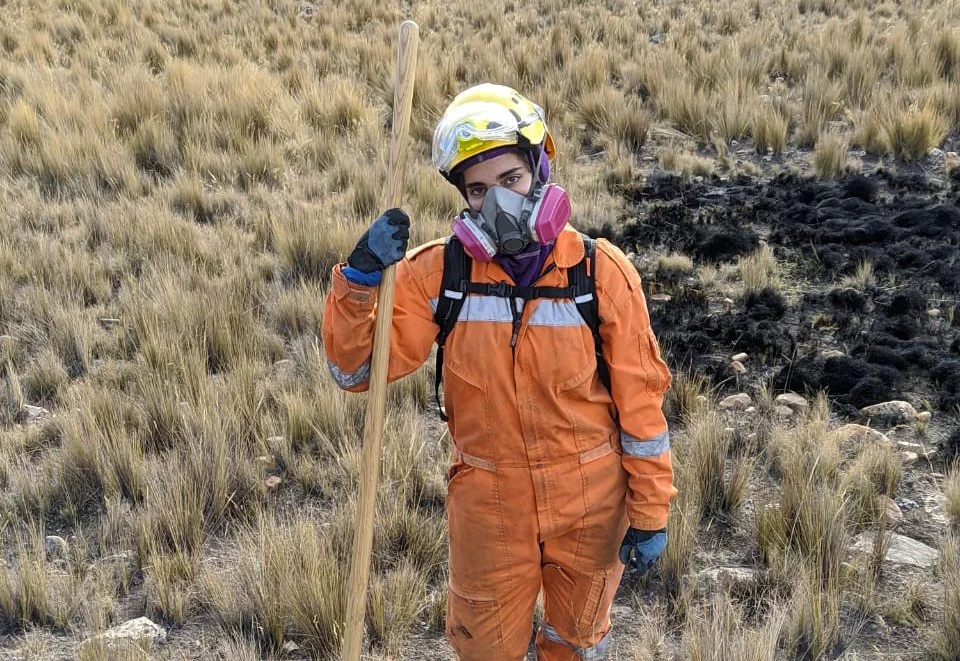
Lastly, it touches on themes like community, identity, belonging, and how my understanding of these concepts has been shaped by people and experiences I had as a volunteer firefighter, as an immigrant, and as a journalist.
CSPF: What has the fellowship and mentorship process been like for you? How has it supported your practice / the development of your craft?
Laura: A key part of this fellowship is that Diaspora Dialogues pairs you with a mentor. In my case, I got to work with Matthew Morris, a writer, speaker, educator, and anti-racism advocate. Having someone so intelligent and deeply committed to social justice engage with my work so meaningfully has made all the difference. When I read his book, I realized two things: our lived experiences were diametrically opposed, and yet he had written the book I aspired to write—a sincere account of the moments and people that shaped his understanding of identity and belonging.
Sometimes I worried that some of the stories I was trying to braid together seemed too dispersed or disconnected, so it was a relief to see Matthew not only find these connections but also show me new ways they come together, and share reflections of his own that ultimately added new layers to the themes I'm so passionate about. Having a mentor also forced me to organize my progress and put things in writing, like the overall structure. In short, I'm incredibly thankful to have a second pair of eyes accompanying me through this process, and I couldn't have asked for a better mentor than Matthew.
CSPF: What was the importance of getting the Carol Shields Prize Fellowship at this point in your career?
Laura: One of the most important changes that came from moving to Canada is embracing the sense of purpose that storytelling has brought into my life, mainly through journalism. And it wasn't until I received the Carol Shields Prize Fellowship that I felt like my story was worth telling, too.
During my program, I took as many creative writing courses as possible, and each one led to a short piece of writing around the themes I shared earlier. So this fellowship—more than coming at a certain point in my career—is actually giving me the push I needed to get it started (a career in writing), by giving me the opportunity to put together a much bigger project than I would’ve envisioned. If this book is coming together now, it’s thanks to my very thoughtful mentor (big hug to Matthew Morris) and the lovely staff at Diaspora Dialogues, whose trust and excitement for my project have offset my impostor syndrome in a way.
CSPF: What does literary community mean to you? How has this Fellowship supported your sense of community?
A while ago, I came across a post that said “everyone wants to be a DJ, but no one wants to dance,” and it really made me think. When it comes to creative work, I believe engaging with other people’s work is as important as creating your own.
When I was in my first year at CapU, a university student who had read a pretty rough creative writing piece I sent to a contest she was helping organize invited me to join a small writing club she was putting together. Three years later, I still meet once a month with the other three members, who have now become some of my closest friends. I still count the days to learn what's going on in the five different universes these talented writers have immersed me in. And, in the days before our meetings, I feel that familiar adrenaline kick to get some writing of my own ready to share. It's a great way to keep each other accountable and build a community around what would otherwise be a very lonely activity.
When I was looking for a potential mentor for the fellowship, I scrolled through the Diaspora Dialogues list of mentors posted on their website, and I was blown away by the number of talented writers who kept appearing as I scrolled. My dear friend and former instructor Tim was also looking through the list to see if he had any suggestions, and he recognized the name of a student he had taught years ago. He said that this student had been in a science program, trying to find a way to tell his parents he wanted to become a writer instead.
That student was now a bestselling author and an alumnus of my university. I reached out to request an interview for our student newspaper, and he immediately made himself available. A contributor from the same country as the author—and with the same passion for writing—was deeply inspired after conducting the interview. I think it's wonderful how Diaspora Dialogues has managed to put together such a supportive community of authors, so ready to share their experiences with aspiring writers, whether formally part of the program or not. I’m grateful for how this fellowship has made me feel part of this literary community.
About Laura Morales:
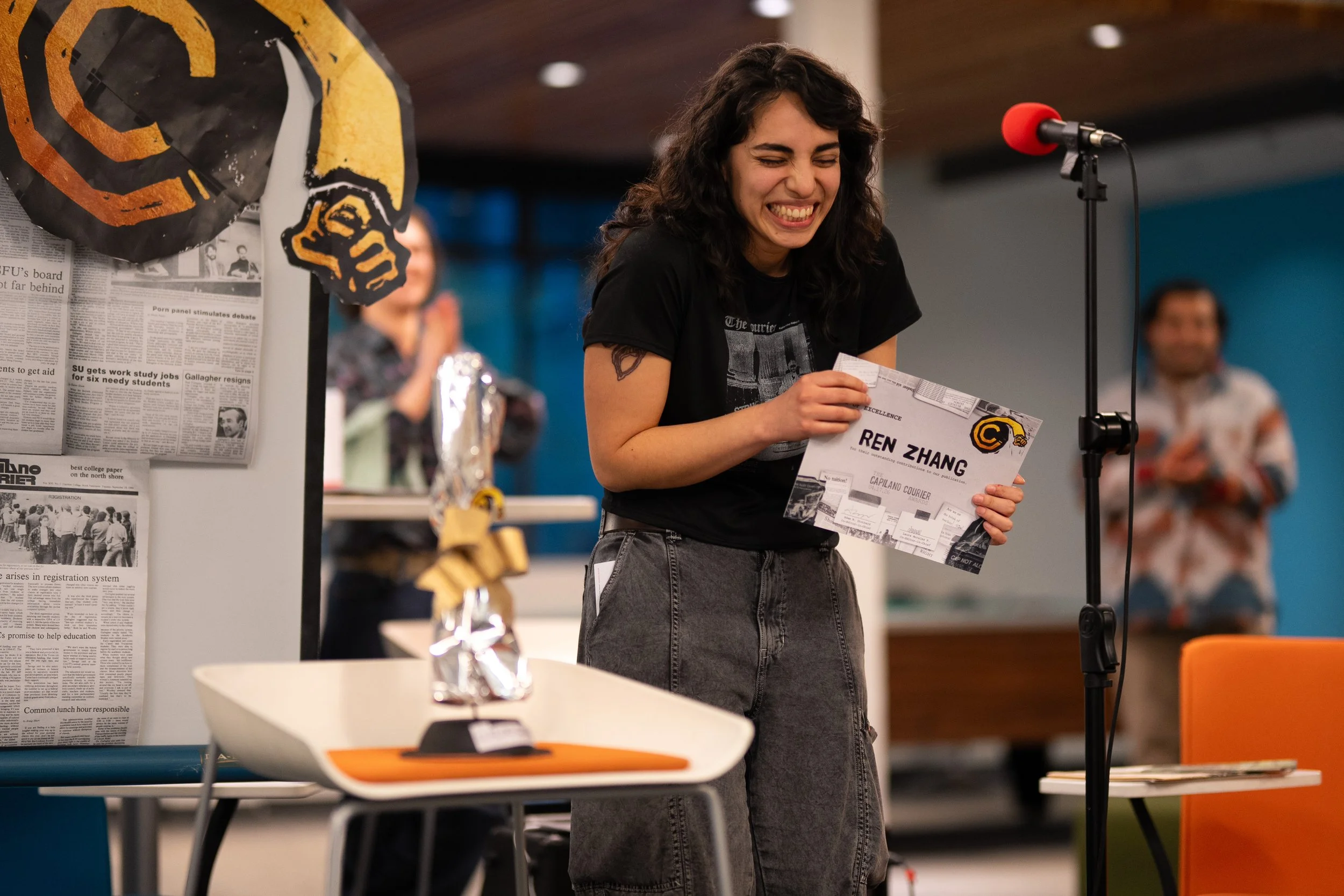
Laura Morales Padilla is a Bolivian journalist and graphic designer passionate about social justice. She moved to Vancouver in 2022 and is currently the Editor-in-Chief at the Capilano Courier. Her experience as an international student has inspired most of her writing and advocacy work, which focuses on the intersection of immigration policy and post-secondary education in Canada. Laura was the winner of the Harbinger Prize for Polemic Writing in 2025, The Liar writing contest in 2024, and the Study in B.C. Writers' Award in 2022.
